Why you got a fine from Hungary: 9 vignette mistakes that cost the most
Most payment demands from Hungary don’t go to people who drove without paying. They go to drivers who did buy a vignette – just an hour too late, with one wrong character in the plate, or in category D1 instead of D2. Here are the mistakes we see again and again, each with a simple way to avoid it.

How Hungary checks motorway vignettes
The Hungarian motorway vignette (e-matrica) is purely electronic. There is no sticker for the windscreen – the vignette is just a database record linking the number plate, country of registration, category and validity period.
Cameras on motorways and expressways read the plates of passing cars and automatically compare them with the database. If the system can’t find a valid vignette in the right category for your plate, a surcharge arises – in Hungarian pótdíj.
Importantly, this is not a police fine but a civil claim of the motorway operator. For foreign vehicles, the operator often hands it over for collection to a law firm or collection agency. Drivers outside Czechia and Slovakia hear, for example, from Euro Parking Collection (EPC) – always acting on behalf of the Hungarian operator.
The 9 most common mistakes that lead to a fine from Hungary
D1 instead of D2 for a vehicle with 8 or more seats
A classic for families, sports clubs and companies. The vehicle has 8 or 9 seats on its registration certificate, so it belongs in category D2 – even if only the driver is inside. What counts is the number of seats recorded on the registration certificate (field S.1), not the number of people on board.
How to avoid it: check field S.1 before buying. 8 or more = D2.
A van or “commercial” passenger car in category N1
Every vehicle with category N1 or N1G in field J of the registration certificate belongs in D2 – regardless of the number of seats. This applies not only to vans but also to cars that look like an ordinary SUV or estate: company cars converted to commercial vehicles (typically with a grille behind the front seats) or pick-ups registered as N1.
How to avoid it: field J on the registration certificate. M1 or M1G → usually D1. N1 or N1G → always D2.
A trailer or caravan behind a D2 vehicle
A trailer or caravan behind a D1 car doesn’t need its own vignette. But as soon as it’s towed by a D2 vehicle (a van, a nine-seater, an N1 vehicle), the trailer needs its own category U vignette.
How to avoid it: have a D2 vignette and tow a trailer? Buy a U vignette for the trailer’s plate as well.
A typo in the number plate
One wrong character and the system can’t “see” your car. The most common mix-ups are 0 and O, 1 and I, a missing character or swapped characters. You’ve paid for a vignette – just for a different plate.
The good news: the operator can correct the plate for an administrative fee of HUF 1,470 (a difference of up to 3 characters, 0/O and 1/I mix-ups free of charge). The bad news: only while the vignette is still valid. Demands usually arrive months later, when the vignette has long expired.
How to avoid it: enter the plate without spaces or hyphens, and check it character by character on the confirmation right after buying. Fix any mistake immediately.
The wrong country code
The same plate can exist in several countries. If you select a different country from the one where the car is registered, the vignette doesn’t belong to your car. A typical trap: SK is Slovakia, SLO is Slovenia.
How to avoid it: always choose the country where the car is registered – the code on your plate.
A vignette bought too late
A vignette is valid from the moment of purchase – to the day, hour and minute. According to the operator, you must have it before entering a toll section. If you enter by mistake, you have at most 60 minutes from entering to buy it. The old “buy it by midnight” rule that many drivers remember no longer applies.
How to avoid it: buy the vignette before you travel, ideally the day before – not at the first petrol station after the border.
A vignette for the wrong dates, or already expired
When buying in advance you can choose the start of validity. One click on the wrong day and the vignette covers a different period from your trip. Another version: the holiday gets longer and on the way back the 10-day vignette has already expired.
How to avoid it: check the start and end of validity on the confirmation – and compare them with the dates of your outbound and return journey.
A county vignette instead of a national one
Besides national vignettes, Hungary also sells annual vignettes for individual counties (vármegyei matrica). These are valid only on toll sections within that county. Drive outside it and you’re driving without a valid vignette.
How to avoid it: driving through Hungary? You need a national vignette.
Buying from an unofficial reseller
Unofficial websites often just “order” the vignette and buy it in your name later, at a higher price and a poor exchange rate. In September 2026 the operator explicitly warned about such websites: the resulting vignette may not have the validity you wanted, and it can’t be changed.
How to avoid it: buy only from official channels – toll-charge.hu, ematrica.nemzetiutdij.hu or the apps of official partners.
The demand always goes to the vehicle’s registered keeper – the rental company, employer or leasing company. They usually pass it on to the driver, often with their own handling fee. With a rental car, always ask whether it has a valid vignette, and in which category.
D1, D2, U, D1M: which Hungarian vignette you need
| Category | Vehicles |
|---|---|
| D1 | Passenger cars up to 3.5 t with at most 7 seats including the driver and category M1 or M1G on the registration certificate – including their trailer. |
| D2 | All other vehicles up to 3.5 t: vehicles with 8 or more seats and all vehicles in category N1 or N1G (vans, commercial vehicles) – regardless of the number of seats. |
| U | A trailer or caravan towed by a D2 vehicle. |
| D1M | Motorcycles. |
Vehicles over 3.5 t don’t buy an e-matrica – they pay a distance-based toll in the HU-GO system.
Where to find it on your registration certificate
Calculator: which Hungarian vignette to buy
Answer four questions using your registration certificate. The result is a guide only – if in doubt, the registration certificate and the operator’s rules decide.
Hungarian motorway vignette prices 2026
| Category | Daily | 10-day | Monthly | Annual |
|---|---|---|---|---|
| D1M | HUF 2,770 | HUF 3,450 | HUF 5,590 | as D1 |
| D1 | HUF 5,550 | HUF 6,900 | HUF 11,170 | HUF 61,760 |
| D2 | HUF 7,890 | HUF 10,040 | HUF 15,820 | HUF 87,650 |
| U | HUF 5,550 | HUF 6,900 | HUF 11,170 | HUF 61,760 |
National vignette prices including VAT, from the operator’s official price list. Official sellers charge the state price in forints.
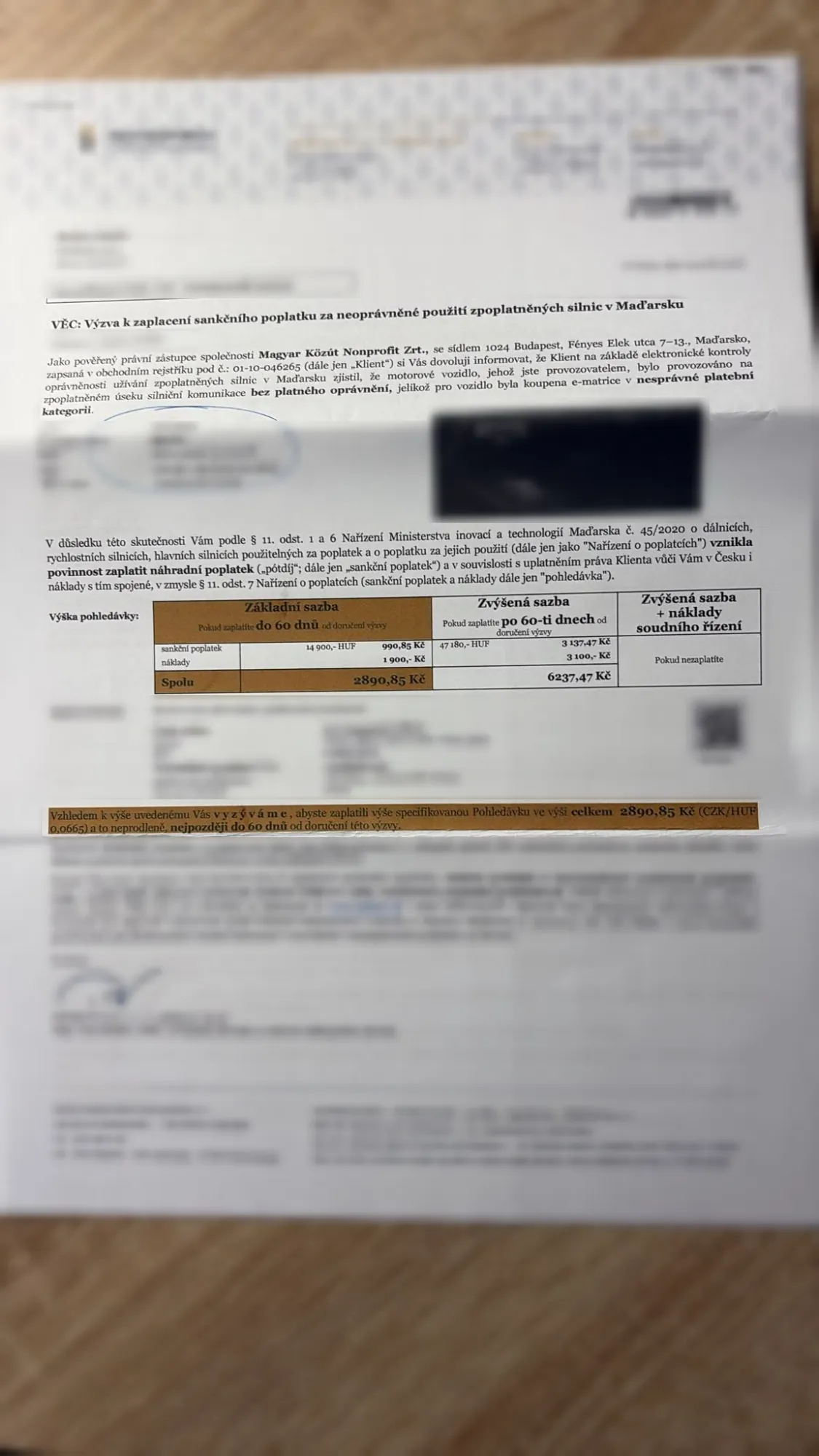
For comparison: the surcharge in the real case above was HUF 14,900 within 60 days and HUF 47,180 after that – more than an annual D1 vignette. And that’s before the collector’s costs.
What to do if a demand from Hungary has already arrived
- Don’t ignore it and don’t panic. A lower rate applies within 60 days of delivery. Write down the date the letter arrived.
- Check the details. Plate, date and time of the trip, road section and category. Do they match what you bought?
- Find out whether the mistake can still be fixed. If the vignette is still valid, ask the operator directly to correct the plate.
- Decide whom to pay and what. The collector acts on behalf of the Hungarian operator and adds its own costs. The original surcharge can be paid directly to the operator.
There is an official procedure that, with several demands, can work out much cheaper than paying each one separately. It has a deadline, so deal with it straight away. Details are in the e-book.
Checklist before buying a Hungarian vignette
- Category based on fields J and S.1 of the registration certificate (D1, D2, U, D1M)
- Number plate character by character, without spaces or hyphens
- Country code – the country where the car is registered
- A national vignette if you drive through more than one county
- Validity – start and end cover both the outbound and return journey
- Trailer behind a D2 vehicle → U vignette
- Official seller, and keep the confirmation for at least 3 years after the vignette expires (operator’s recommendation)
FAQ: fines from Hungary
What is the difference between the D1 and D2 vignette in Hungary?
D1 is for passenger cars up to 3.5 t with at most 7 seats including the driver and category M1 or M1G on the registration certificate. D2 is for other vehicles up to 3.5 t – vehicles with 8 or more seats and all vehicles in category N1 or N1G (vans, commercial vehicles), regardless of the number of seats.
Which Hungarian vignette does a van need?
A van up to 3.5 t usually has category N1 on its registration certificate, so it needs a D2 vignette. This also applies to passenger cars converted to commercial vehicles (N1G) and pick-ups registered as N1.
Does a trailer or caravan need its own vignette in Hungary?
A trailer or caravan behind a D1 car doesn’t need its own vignette. A trailer towed by a D2 vehicle needs its own category U vignette.
How much is the fine for a missing vignette in Hungary?
The surcharge (pótdíj) depends on the category and on when you pay. In a real case with D1 instead of D2 it was HUF 14,900 if paid within 60 days and HUF 47,180 after 60 days. The collector added its own costs on top in the demand.
Can I buy a Hungarian vignette retroactively?
No. A vignette is valid from the moment of purchase. If you enter a toll section by mistake without a vignette, you have at most 60 minutes from entering to buy one. The old “buy it by midnight” rule no longer applies.
Can a typo in the plate be corrected on a Hungarian e-matrica?
Yes, but only while the vignette is valid. The correction costs HUF 1,470 and up to 3 characters can be corrected; a 0/O or 1/I mix-up is corrected free of charge. The year of validity can’t be changed afterwards.
Who sends me the fine from Hungary?
The creditor is the Hungarian motorway operator. For foreign drivers, the demand is often sent by a law firm or collection agency on its behalf – for example Euro Parking Collection (EPC).
Do I have to pay a fine from Hungary?
Don’t ignore the demand – after 60 days the amount increases and collection can go as far as court. The original surcharge can be paid directly to the Hungarian operator. The e-book Fine from Hungary explains exactly how.
This article is for information only and is based on practical experience and on the operator’s information as of the date of update (5 October 2026). It is not legal advice. We are not affiliated with the Hungarian motorway operator or with any law firm or collection agency.